
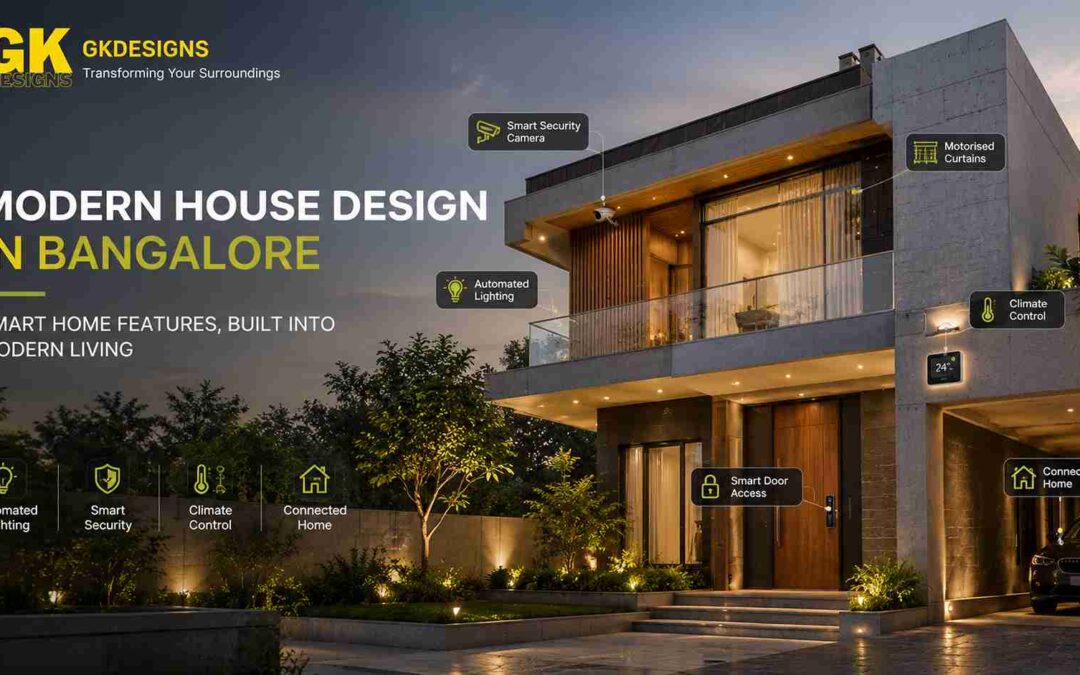
A modern home today is not just about clean elevations, open spaces or large glass windows. Technology is becoming part of how a house is experienced every day—from switching lights and controlling curtains to monitoring security and managing indoor comfort.
For homeowners considering Modern House Design in Bangalore, smart features can be especially useful when they are planned around the site’s conditions, family routines and future needs. The goal is not to fill every room with gadgets, but to make the home more responsive, comfortable and easier to manage.
At GK Designs, technology can be considered alongside architecture, interiors, electrical planning and services so that smart features feel like a natural part of the house rather than something added after construction.
Smart Features Should Solve Real Everyday Problems
A smart home does not become better simply because it has more connected devices. The useful question is whether each feature makes something easier.
A family may want automated lighting because different rooms are used at different times. Another household may prioritise smart locks and cameras because security is a concern. Someone working from home may benefit more from automated blinds, climate controls and reliable connectivity.
This makes the starting point simple:
Identify the routine → Find the problem → Choose the technology → Plan it into the house.
That approach keeps automation practical instead of turning the home into a collection of unnecessary devices.
Plan Technology Alongside the Architecture
Smart features are easier to integrate when they are considered before construction begins.
- Map daily routines
Identify how different members of the household use bedrooms, kitchens, living spaces, studies and outdoor areas. - Assign technology to specific spaces
Decide where lighting controls, sensors, cameras, smart locks and climate controls would actually be useful. - Coordinate electrical requirements
Switches, sockets, circuits and equipment locations need to work with the architectural and interior layout. - Plan connectivity early
Routers, access points and network equipment should have suitable locations rather than being hidden wherever space is left over. - Leave room for upgrades
Technology changes quickly, so the infrastructure should allow new devices and systems to be introduced later.
This is an important part of Modern House Design in Bangalore, where architectural planning and technical coordination need to work together from the early stages.
Smart Features Worth Considering
Not every feature belongs in every home. The right combination depends on the household, budget and level of automation required.
| SMART FEATURE | USEFUL FOR | PLANNING REQUIREMENT |
|---|---|---|
| Automated Lighting | Schedules, scenes and energy control | Smart switches and electrical circuits |
| Smart Security | Cameras, sensors and remote monitoring | Camera positions and network access |
| Smart Curtains | Privacy, daylight and shading | Power points and curtain provisions |
| Climate Controls | Temperature and room comfort | HVAC and sensor coordination |
| Smart Locks | Controlled home access | Compatible door hardware |
| Home Networking | Reliable connected devices | Router and access-point locations |
| Voice Controls | Hands-free operation | Compatible smart ecosystem |
The strongest solution is usually a combination of features that work together rather than several unrelated products.
Security Begins With the Site and Entry Plan
Smart security works best when technology supports good architectural planning.
A camera should have a useful view of the entrance. Sensors should cover meaningful access points. Smart locks should be positioned where they are convenient without compromising the entry design.
A residential security plan can include:
Gate → Driveway → Main Door → Internal Access → Private Areas
Each point can be considered separately rather than installing cameras and sensors without a clear purpose.
Smart doorbells, access controls, motion sensors and remote monitoring can then complement physical boundaries, lighting and visibility.
The result is a more coordinated security strategy rather than simply adding surveillance equipment to the finished house.
Bangalore’s Climate Still Comes Before Automation
Technology can improve comfort, but it should not be used to compensate for poor architectural decisions.
Orientation, shading, window placement, ventilation and glazing influence how much heat enters the house and how naturally it can remain comfortable.
Smart systems can then add another layer of control.
Good orientation
↓
Better daylight and ventilation
↓
Reduced dependence on artificial lighting and cooling
↓
Smart controls fine-tune energy use
This combination makes Modern House Design in Bangalore more responsive to the local climate without depending entirely on mechanical systems.
Automated Curtains Can Balance Light and Privacy
Large openings are often part of contemporary residential architecture. They bring daylight and views into the home, but they can also create privacy and heat-control challenges.
Automated curtains or blinds can respond to different times of day.
For example:
- Open during suitable daylight hours
- Close during stronger sunlight
- Adjust for evening privacy
- Coordinate with lighting scenes
- Operate remotely when the house is unoccupied
The architectural detail matters here. Curtain tracks, recesses, power points and furniture placement should be considered before the interiors are completed.
Reliable Connectivity Is Part of Smart Home Planning
A smart home depends on more than individual devices. It also needs a dependable network.
A larger house may contain televisions, cameras, laptops, phones, speakers, appliances and automation equipment operating simultaneously. Poor Wi-Fi coverage can quickly turn a convenient system into a frustrating one.
Connectivity Checklist
✓ Identify areas where strong connectivity is required
✓ Position routers and access points strategically
✓ Provide suitable locations for network equipment
✓ Keep essential equipment accessible for maintenance
✓ Consider future devices before finalising infrastructure
✓ Avoid treating networking as an afterthought
For a technology-enabled Modern House Design in Bangalore, connectivity should be considered part of the home’s basic infrastructure.
Choose One Connected Smart Home Ecosystem
Buying individual smart products because each one looks attractive can create problems later.
One device may use one application, another may require a different platform and a third may not communicate with either. The result is a home that is technically smart but inconvenient to operate.
Before choosing products, consider:
| CHECK BEFORE BUYING | WHY IT MATTERS |
|---|---|
| Compatibility | Devices should work together where possible |
| Ease of Use | Family members should be able to operate the system |
| Reliability | Important functions should remain dependable |
| Scalability | New devices should be easy to add |
| Support | Maintenance should not become difficult |
| Manual Control | Essential functions should have simple alternatives |
The objective is a system that reduces complexity rather than creating another layer of it.
Smart Technology Can Support Energy Efficiency
Automation becomes more useful when it helps the household avoid unnecessary consumption.
Occupancy sensors
→ Lights can switch off when spaces are unused.
Scheduled cooling
→ Air-conditioning can follow actual occupancy instead of running continuously.
Automated shading
→ Curtains or blinds can respond to sunlight and privacy requirements.
Smart monitoring
→ Homeowners can understand where energy is being consumed.
However, smart controls are only one part of the equation. Efficient appliances, appropriate glazing, shading, ventilation and passive design strategies remain important.
Keep Automation Simple for the Whole Family
A smart home should not require everyone to become a technology expert.
Basic functions should remain easy to operate. A visitor should be able to use the lights without needing an application. A family member should still be able to control essential systems manually when required.
Good automation often works quietly in the background.
One command → Multiple coordinated actions
For example, an evening scene might reduce selected lights, close the curtains and adjust the living room environment at the same time.
That kind of simplicity is more useful than having dozens of complicated functions that nobody uses.
Design Today for Tomorrow’s Technology
Technology will change much faster than the structure of a house.
A smart switch or camera installed today may eventually be replaced by something better. The house therefore needs flexibility rather than being designed around one particular product.
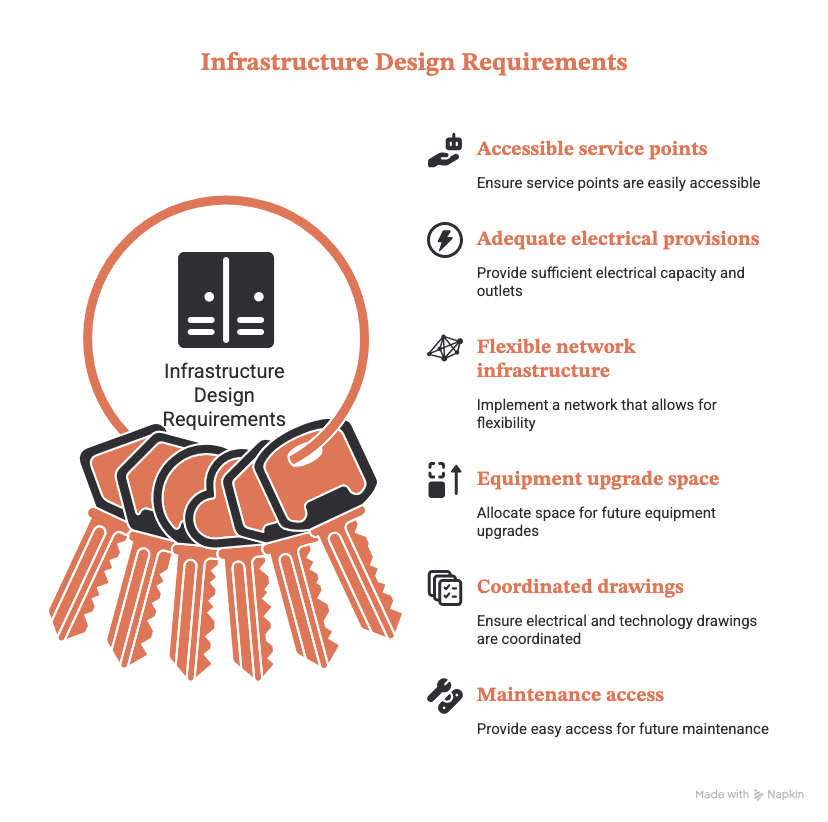
Future-Ready Planning Can Include
- Accessible service points
- Adequate electrical provisions
- Flexible network infrastructure
- Space for equipment upgrades
- Coordinated electrical and technology drawings
- Easy access for future maintenance
This allows the home to evolve without requiring major changes every time a new smart technology becomes available.
A Smart Home Should Feel Natural to Use
Lights respond when needed. Curtains provide privacy without effort. Security can be checked remotely. Cooling follows the family’s routine. Connectivity works across the house. And when something needs to be operated manually, the process remains straightforward.
For homeowners planning Modern House Design in Bangalore, the strongest results come from combining technology with thoughtful architecture, climate-responsive planning and practical lifestyle decisions. When these elements are coordinated from the beginning, smart features can improve the everyday experience without compromising the simplicity and character of the home.
GK Designs can bring these considerations together during the residential design process, creating modern homes where technology works quietly behind the architecture rather than competing with it.