
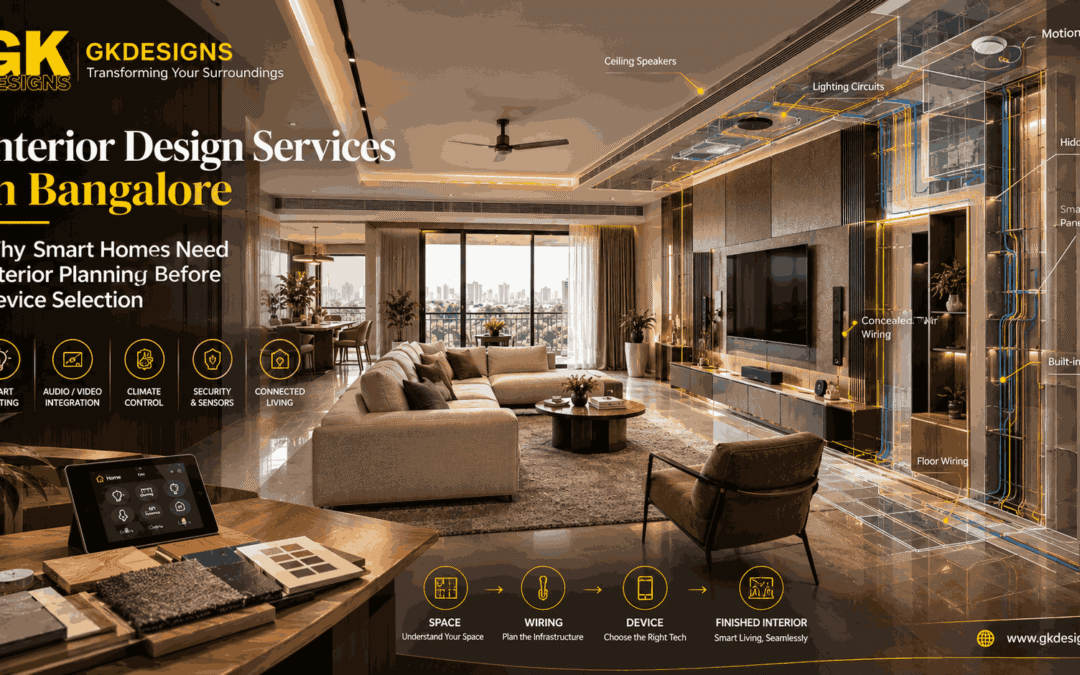
A smart home can have impressive technology and still have an ordinary interior problem: the devices were chosen before anyone decided where they should actually live.
A sensor ends up beside a curtain. A speaker occupies valuable shelf space. A router is hidden inside a cabinet where its signal suffers. A motorised curtain needs wiring that was never planned. A smart switch does not match the electrical layout. None of these issues comes from the technology itself. They come from introducing technology too late.
That is why Interior design services in Bangalore increasingly need to consider smart-home requirements while the interior is still being planned. The objective is not to make every part of a home automated. It is to make technology, architecture, furniture, lighting and electrical infrastructure work as one system.
Start With the Experience, Not the Product Catalogue
A homeowner may say they want a smart home, but that can mean very different things.
One family may want automated lighting and curtains. Another may prioritise security. Someone working from home may care more about connectivity and device charging. Another homeowner may want entertainment systems to disappear visually.
The design should begin by defining these expectations.
Lifestyle requirement → desired experience → technical requirement → spatial planning → product selection
This order matters.
If a specific device is selected first, the room may have to adapt around it. If the experience comes first, the technology can be selected to support the space.
That is where Interior design services in Bangalore can add value before the shopping stage begins.
A Small Site Detail Can Change a Big Design Decision
Interior planning often looks straightforward on paper. A wardrobe fits along one wall. A television unit fits opposite the sofa. A kitchen appears to have enough room for all the required storage.
Then the site visit happens.
A window may open into the proposed wardrobe zone. A switchboard may sit exactly where a panel was planned. A beam may lower the usable ceiling height. A door swing may interfere with a piece of furniture.
None of these details necessarily creates a major problem. But each can change the design.
Site observation → design adjustment → better execution
That chain is important because a small correction during planning is usually easier than a major correction after installation.
Every Device Creates a Small Design Requirement
Smart devices may be compact, but they are not physically irrelevant.
A motion sensor needs visibility. A camera needs a clear angle. A smart speaker needs suitable positioning. A charging station needs accessibility. A hub needs connectivity. A motorised curtain needs space around its mechanism.
Individually, these requirements seem insignificant. Together, they can affect an entire room.
For example, placing a motion sensor behind a decorative partition may preserve the appearance of the wall but reduce its usefulness. Installing a smart speaker inside tightly enclosed cabinetry may make the device difficult to hear or access.
The Electrical Layout Has to Think Ahead
The electrical plan is no longer just about placing enough sockets around the home.
Modern interiors may include televisions, workstations, charging areas, automated curtains, lighting controls, sensors, speakers, routers and kitchen appliances. Smart features add another layer of coordination.
A properly planned interior can identify these requirements before walls are closed and carpentry begins.
| SMART REQUIREMENT | INTERIOR DECISION |
|---|---|
| Automated lighting | Switch locations and lighting circuits |
| Motorised curtains | Power provision near windows |
| Smart security | Camera positions and cable routes |
| Home network | Router and access-point locations |
| Entertainment | TV wall, speakers and cable management |
| Smart appliances | Accessible power and service provisions |
This is one of the practical reasons Interior design services in Bangalore should be involved before device specifications are finalised.
The Clean Interior You See Has Infrastructure Behind It
Minimal interiors often look effortless because the visible clutter has been carefully controlled.
Smart-home systems make this even more relevant.
Cables may need to travel through walls or ceilings. Hubs may need equipment storage. Speakers may need ceiling integration. Sensors may need carefully chosen positions.
The cleaner the desired appearance, the more coordination happens behind the surface.
Visible technology needs visual placement.
Partially concealed technology needs furniture and finish coordination.
Fully integrated technology needs electrical, ceiling, carpentry and architectural coordination.
This is why hiding technology should never be treated as an afterthought.
Your Ceiling Has More Jobs Than You Think
A ceiling may contain lighting, air-conditioning provisions, speakers, sensors, curtain mechanisms and electrical routes.
Once several systems compete for the same space, the ceiling design becomes a coordination exercise.
A decorative ceiling pattern may need to change because of a speaker location. A recessed light may need to move to accommodate an air-conditioning outlet. A concealed curtain track may affect the edge detail near a window.
For Interior design services in Bangalore, early ceiling coordination can prevent multiple teams from solving the same space independently.
The aim is simple: every element should have a place before installation begins.
Connectivity Has to Follow the Shape of the Home
A smart home depends on communication between devices, and that means network planning deserves attention.
Large homes, multiple floors, thick walls and enclosed spaces can create connectivity challenges. Simply placing a router near an available socket does not necessarily produce reliable coverage.
Interior planning can consider:
- Where network equipment can be positioned
- Where access points may be required
- How cables can be routed discreetly
- Which areas may interfere with signal
- How equipment can remain accessible
This does not mean turning an interior project into a networking project. It means recognising that connected technology still depends on physical infrastructure.
A Device Should Never Become a Design Constraint
Imagine buying a large smart television before finalising the entertainment wall.
Or choosing motorised curtains before deciding the ceiling detail.
Or purchasing smart switches without checking the electrical system.
The product may be excellent, but the timing creates the problem.
With Interior design services in Bangalore, device specifications can instead be checked against the space before purchase.
That means asking:
- Does it physically fit?
- Does it need dedicated power?
- Does it require a network connection?
- Can it be serviced later?
- Will it affect furniture placement?
- Does it suit the intended finish?
- Can an alternative provide the same function more cleanly?
These questions prevent technology from dictating the interior unnecessarily.
Maintenance Is Part of Smart Design
A system that looks perfect on handover day may become frustrating later if no one can reach its components.
Technology needs updates, servicing and eventually replacement.
So concealed does not have to mean permanently sealed.
Access panels, removable cabinet sections, reachable connections and sensible equipment locations can make future maintenance easier.
This is particularly important for devices installed inside ceilings, cabinetry or wall features.
A genuinely thoughtful interior considers not only how the system will look when new, but also how someone will access it several years later.
Technology Should Disappear Into the Design
The most successful smart-home interiors do not necessarily look “smart.”
There may be no visible collection of gadgets competing for attention. Instead, the technology quietly supports everyday activities.
Lights respond when needed. Curtains operate smoothly. Entertainment systems remain organised. Security works in the background. Charging is convenient. Connectivity remains reliable.
That is where Interior design services in Bangalore become more than a styling exercise. The interior has to accommodate the infrastructure that makes these experiences possible.
GK Designs Connects Interior Thinking With Technology
At GK Designs, smart-home planning can be considered alongside space planning, electrical layouts, furniture, ceilings, lighting and execution.
The purpose is not to add technology simply because it is available. It is to determine where technology genuinely improves the way a home functions and then create the right interior conditions for it.
That approach also helps avoid late-stage changes, visible cables, awkward device placement and unnecessary rework.
A smart home works best when its technology feels like it belonged there from the beginning.
The Smartest Decision May Happen Before You Buy Anything
Once that is clear, the interior can make room for the electrical infrastructure, connectivity, furniture, lighting, ceilings and access requirements that support those functions.
For homeowners exploring Interior design services in Bangalore, this is an important distinction. Smart interiors are not created by adding more gadgets. They are created by planning the space well enough for technology to work without disrupting it.
The best result is a home where the technology performs its job quietly while the interior continues to feel like a home.