
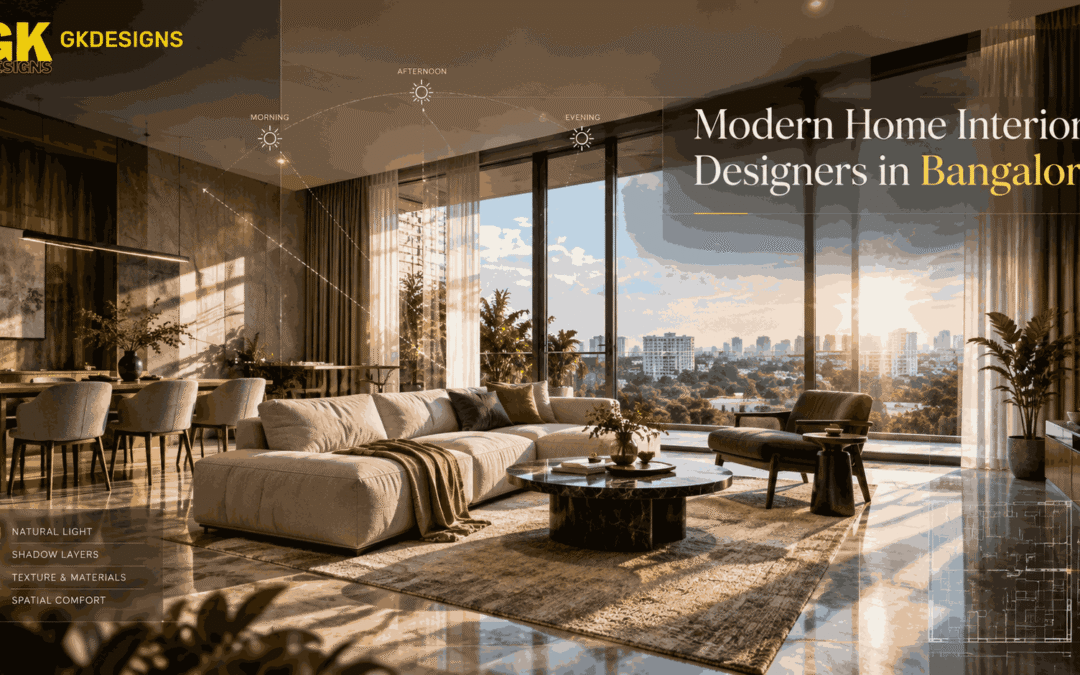
A modern interior can look completely different depending on the light entering the room.
The same beige wall may appear warm in the morning, neutral at midday, and noticeably deeper in the evening. A glossy surface can catch intense daylight and become distracting, while a textured finish may reveal subtle depth as the sun moves across the room.
For homes in Bangalore, daylight is therefore more than a source of brightness. It affects colour perception, material selection, furniture placement, glare, privacy, and even how comfortable a room feels throughout the day.
This is one reason Modern Home Interior Designers in Bangalore need to consider the relationship between architecture and natural light before finalising finishes. At GK Designs, lighting is treated as part of the spatial design rather than something considered after furniture and materials have been selected.
Bangalore Light Is Not the Same Throughout the Day
Morning and afternoon light enter a room from different angles, changing its brightness, warmth, shadows, and overall appearance. A space that feels soft and inviting in the morning may become brighter, warmer, or more reflective as the day progresses. Observing these changes helps reveal how the room naturally responds to daylight.
Morning light can show the direction, warmth, and intensity of natural illumination, while midday helps identify glare, brightness, and reflections on surfaces. These observations can influence wall colours, flooring, furniture placement, curtains, and material finishes. A finish that looks balanced in the morning may appear completely different under stronger afternoon light.
Window Direction Can Change the Material Palette
A finish that looks balanced in a showroom may behave differently inside a Bangalore home.
Strong daylight can make pale surfaces appear brighter and increase the visibility of reflections. A darker material may absorb more light and create a deeper atmosphere.
For Modern Home Interior Designers in Bangalore, this makes material selection more contextual.
A room with abundant daylight may support:
- Deeper accent colours
- Matte textures
- Natural wood tones
- Stone with controlled reflection
- Layered curtains
- Subtle contrast
A darker room may benefit from:
- Lighter wall finishes
- Reflective but controlled surfaces
- Open furniture arrangements
- Lighter fabrics
- Carefully positioned mirrors
The objective is not to make every room equally bright. It is to make the available light work with the intended character of the space.
Modern Design Needs Control, Not Maximum Brightness
Modern interiors often use clean surfaces, large windows, glass, polished materials, and uncluttered compositions.
A glossy cabinet beside a large window, for example, may reflect daylight directly into the room. A television positioned opposite a bright opening can create screen glare. A polished stone surface may produce highlights that become distracting at certain times.
Instead, designers can balance them with:
Matte surfaces → reduce excessive reflection
Textured finishes → create softer visual depth
Curtains or blinds → control incoming brightness
Layered lighting → maintain comfort after daylight fades
Strategic furniture placement → reduce direct glare
This is where the work of Modern Home Interior Designers in Bangalore becomes more detailed than simply selecting fashionable finishes.
Colour Looks Different Under Bangalore Daylight
Colour selection is often treated as a catalogue exercise.
But paint, fabric, laminate, wood, stone, and upholstery can all change visually depending on the light surrounding them.
A warm neutral can become noticeably warmer under certain daylight conditions. A cool grey may appear more subdued in a low-light room. Off-white can reveal undertones that are difficult to notice under artificial showroom lighting.
This is why physical samples are valuable.
Instead of judging a material only under store lighting, homeowners can examine samples:
- Near the actual window
- Against the intended flooring
- Beside proposed furniture
- During morning and afternoon
- Under the planned artificial lighting
This creates a more realistic understanding of how the finished room may look.
Natural Light Can Influence Furniture Placement
Furniture should not automatically be arranged around walls.
The position of windows, sunlight, views, circulation, and glare can influence where major pieces should sit.
For example, placing a sofa directly in front of a window may obstruct daylight and views. Positioning a television opposite a strong opening may create glare. A work desk placed beside a bright window may provide excellent daylight but require shading during certain hours.
The solution depends on the room’s purpose.
For Modern Home Interior Designers in Bangalore, furniture planning therefore becomes a lighting decision as well as a spatial decision.
The strongest layouts consider:
Where light enters → where people sit → what surfaces reflect it → how the room is used
That sequence can prevent problems that only become obvious after installation.
Curtains Become Part of the Interior Architecture
Window treatments are sometimes treated as finishing accessories.
In a light-conscious modern interior, they can be much more important.
A layered window treatment can provide flexibility throughout the day. A sheer layer can soften incoming daylight while maintaining a connection with the outdoors. A heavier layer can provide privacy, reduce glare, and control brightness when necessary.
The fabric itself also contributes to the visual language of the room.
A simple neutral curtain can support a minimalist interior, while a textured fabric can introduce warmth into a space dominated by hard surfaces.
The goal is controlled daylight rather than completely blocking it.
Mirrors Need Careful Placement Around Windows
Mirrors can visually expand a room and help distribute light, but placement matters.
A mirror directly facing strong daylight can create unwanted reflection. Positioned thoughtfully, however, it can bounce softer light into a darker part of the room.
This is particularly useful in apartments where the amount of natural light is limited.
Rather than automatically adding a large mirror because the room feels small, designers can first determine:
- Where daylight enters
- What the mirror will reflect
- Whether the reflection creates glare
- What visual element will appear in the mirror
That last point matters.
A mirror should ideally reflect something worth seeing—not simply another wall, cluttered surface, or television.
Artificial Lighting Should Continue the Daylight Story
A room should not feel disconnected once the sun goes down.
Artificial lighting can continue the visual character established by daylight.
Instead of relying on one bright ceiling fixture, a modern home can use layers:
- Ambient lighting for overall illumination
- Task lighting for specific activities
- Accent lighting for artwork and architectural features
- Decorative lighting for visual character
The colour temperature and intensity should also complement the materials already selected.
A warm evening lighting scheme can soften timber, stone, fabrics, and textured finishes. The transition from daylight to artificial light should feel natural rather than abrupt.
Different Rooms Need Different Light Strategies
A home’s lighting response should follow its function.
This is why a single lighting formula rarely works across an entire home.
| ROOM | DAYLIGHT CONSIDERATION |
|---|---|
| Living Room | Views, glare control and comfortable social lighting |
| Bedroom | Softness, privacy and controlled morning light |
| Kitchen | Clear task illumination and reduced work-surface glare |
| Study | Useful daylight without screen reflections |
| Dining Room | Atmospheric lighting with controlled window brightness |
| Bathroom | Privacy, balanced illumination and surface reflection |
The Modern Home Interior Designers in Bangalore approach needs to respond to how each room is occupied and when it is most frequently used.
Let Daylight Influence the Final Details
The most successful modern interiors do not treat daylight as something that simply enters through a window.
They allow it to interact with the entire design.
At GK Designs, this can mean examining how a material changes under sunlight, where a shadow falls across a wall, how a curtain filters brightness, or whether a particular finish becomes too reflective during the afternoon.
These observations can influence seemingly small decisions:
Wall finish → furniture fabric → flooring tone → window treatment → lighting temperature
Small adjustments can have a noticeable cumulative effect.
Design the Interior You Will Actually Experience
A material board may look perfect under studio lighting. A 3D render may show a beautifully balanced room. But a home is experienced at 8 a.m., 1 p.m., 5 p.m., and after sunset.
For homeowners working with Modern Home Interior Designers in Bangalore, asking how natural light has influenced the design can reveal how thoughtfully the interior has been planned.
At GK Designs, the objective is not simply to create a modern-looking room. It is to create an interior that responds to its actual setting its windows, orientation, materials, climate, routines, and changing daylight.
Bangalore’s light can become part of the design language itself.
When the interior works with that light instead of fighting it, modern design becomes more comfortable, more nuanced, and more connected to the home it belongs to.