
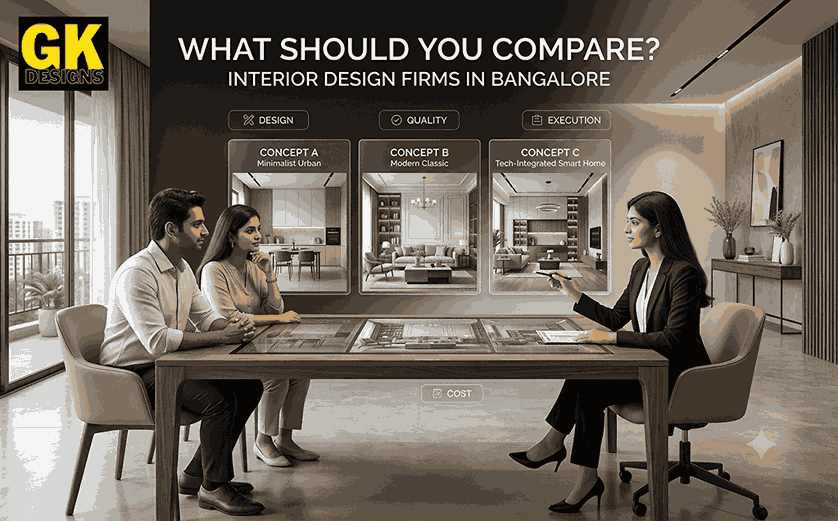
Choosing an interior design partner is not simply about selecting attractive furniture, colours, or finishes. The right team should understand how a space needs to function, how much the project can realistically cost, and how design decisions will translate into execution.
With many interior design firms in Bangalore offering different styles, packages, and approaches, comparing them only through photographs can make the decision harder.
A better approach is to evaluate the thinking behind the design.
For homeowners, apartment owners, and commercial clients, the important question is not only “Does this look good?” It is also “Will this design work well for my space, lifestyle, budget, and long-term needs?”
GK Designs approaches interior design by connecting visual character with practical planning, functionality, material selection, and project requirements.
Start by Defining What Your Interior Project Really Needs
Before contacting different designers, establish what you expect from the project.
An interior project may involve:
- Complete home interiors
- Apartment interiors
- Villa interiors
- Individual room design
- Kitchen and wardrobe planning
- Office interiors
- Commercial spaces
- Renovation or redesign
- Furniture and lighting coordination
Each requirement calls for a different design strategy.
For example, a compact apartment may need careful storage planning and space optimisation, while a large villa may require stronger attention to zoning, circulation, proportions, lighting, and material combinations.
Having clarity about your requirements helps you compare interior design firms in Bangalore based on project suitability rather than popularity alone.
Define Your Interior Project Needs Before Choosing a Designer
A portfolio is useful, but it should not be the only factor behind your decision.
Two designers may show equally impressive living rooms while having completely different approaches to planning.
Look beyond the final photographs.
Ask:
- How was the layout developed?
- How were storage requirements addressed?
- Why were particular materials selected?
- How was natural light considered?
- How does the design support movement?
- Were maintenance requirements considered?
- How closely does the design reflect the client’s lifestyle?
A strong interior design process should demonstrate reasoning behind design decisions.
At GK Designs, the focus can begin with understanding how the client uses the space before translating those requirements into layouts, materials, colours, lighting, furniture, and detailing.
Check Whether the Designer Understands Bangalore Homes
Bangalore has a wide range of residential properties, from compact apartments to independent homes and luxury villas.
The design requirements can therefore vary significantly.
An apartment may have limitations involving:
- Existing electrical points
- Plumbing locations
- Structural elements
- Ceiling height
- Builder specifications
- Limited storage
- Society guidelines
Independent homes may provide greater flexibility but often involve more coordination between architecture, interiors, services, and construction.
A designer familiar with these practical conditions can identify potential challenges earlier.
This is one reason clients should assess interior design firms in Bangalore based on their ability to respond to local project conditions rather than simply choosing a particular visual style.
Evaluate How the Design Handles Space and Movement
Good interiors should make a space easier to use.
A beautiful room can still feel uncomfortable if furniture blocks movement or storage is poorly positioned.
During the design stage, consider how people will:
- Enter the room
- Move between spaces
- Use furniture
- Access storage
- Work or study
- Entertain guests
- Clean and maintain the space
For homes, circulation becomes particularly important in kitchens, living rooms, bedrooms, and transitional areas.
A well-planned interior does not necessarily mean filling every available area. Sometimes, leaving the right amount of open space creates better functionality and visual balance.
Ask How Materials Are Selected for Real-Life Use
Material selection should involve more than colour and appearance.
A surface that looks attractive in a showroom may not necessarily be appropriate for everyday use.
| Factor | Question to Consider |
|---|---|
| Durability | Can it withstand expected usage? |
| Maintenance | Is it easy to clean and maintain? |
| Moisture | Is it suitable for the location? |
| Availability | Can it be sourced within the project timeline? |
| Cost | Does it provide suitable value? |
| Finish | Does it complement the overall design? |
The best interior design firms in Bangalore should be able to explain why a particular material is being recommended rather than simply presenting it as a design trend.
This creates a more informed decision-making process for the client.
Look Closely at Storage Planning and Daily Function
Storage is one of the areas where interior design directly affects everyday life.
A visually minimal home can quickly become cluttered when storage has not been planned properly.
Designers should consider:
- Wardrobe requirements
- Kitchen storage
- Utility areas
- Shoe storage
- Linen storage
- Books and display items
- Appliances
- Cleaning equipment
- Frequently used belongings
Storage should also be positioned according to usage frequency.
Items used every day should remain accessible, while seasonal or rarely used belongings can be accommodated in less accessible locations.
This is where detailed planning can make an interior feel significantly more organised without making it feel crowded.
Understand the Difference Between Design and Execution
A strong concept is only the beginning of an interior project.
The final outcome depends on how accurately the design is translated into physical work.
Execution can involve:
Design concept
↓
Space planning
↓
Material selection
↓
Detailed drawings
↓
Procurement
↓
Fabrication
↓
Site installation
↓
Quality checks
Each stage can influence the final result.
This makes project coordination an important factor when comparing interior design firms in Bangalore.
Clients should understand who is responsible for coordinating vendors, checking dimensions, reviewing materials, and monitoring site progress.
Treat the Budget as a Design Input, Not a Final Number
Budget should be considered from the beginning.
Instead of asking only for the final project price, understand what contributes to it.
The overall cost may be influenced by:
- Materials
- Furniture
- Hardware
- Lighting
- Electrical work
- False ceiling
- Flooring
- Painting
- Custom fabrication
- Installation
- Accessories
- Site conditions
A designer should help the client understand where the budget is being allocated.
At GK Designs, the objective is to create design solutions that balance aesthetics, functionality, material choices, and practical project considerations.
Choose an Interior Partner Based on Project Fit
There is no universal definition of the best interior designer for every project.
The right choice depends on factors such as:
Project type – Does the firm handle projects similar to yours?
Design approach – Does its process match your expectations?
Portfolio relevance – Has it worked with comparable spaces?
Execution capability – Can the design be translated accurately on site?
Communication – Is the process transparent?
Budget alignment – Can the proposed solutions work within your financial plan?
Material knowledge – Can the team explain practical differences between options?
Personalisation – Does the design respond to how you actually live or work?
These criteria are more useful than choosing a firm solely because it appears frequently in online searches.
Why GK Designs Takes a Practical Design Approach
GK Designs views interiors as more than decorative improvements.
The process can connect the client’s requirements with spatial planning, functionality, materials, aesthetics, and execution considerations.
Instead of beginning with a particular colour palette or furniture trend, the design process can start with practical questions:
- Who will use the space?
- How will they move through it?
- What needs to remain private?
- Where is storage required?
- How should natural light be used?
- What needs to be flexible?
- Which materials are suitable?
- How should the space feel over time?
The answers help shape an interior that is visually considered while remaining useful in everyday life.
For clients comparing interior design firms in Bangalore, this project-specific approach can provide a more meaningful basis for evaluating design partners.
Build an Interior That Works Beyond the First Impression
The strongest interiors are not necessarily the ones with the most expensive materials or the most dramatic photographs.
They are spaces where planning, functionality, aesthetics, comfort, and execution work together.
When comparing interior design firms in Bangalore, look beyond trends and social-media images. Examine their process, project experience, material knowledge, communication, execution approach, and ability to adapt the design to your requirements.
With a thoughtful approach, your interior can become more than a visually attractive space. It can become a practical environment designed around the way you actually live and work.
GK Designs focuses on bringing together design thinking and practical planning to create interiors that are purposeful, personalised, and suited to the requirements of each project.