

Your home should reflect the way you live, not simply follow a standard design template. A residential architect helps transform your ideas, lifestyle needs, and site conditions into a thoughtful architectural plan. From planning spaces and improving natural light to selecting suitable materials and coordinating technical drawings, the right architect can play an important role in creating a home that is both visually appealing and practical for everyday living.
For homeowners searching for a Residential Architect in Bangalore, the selection process can feel overwhelming. Most firms have portfolios filled with attractive homes, and many can present impressive concepts during an initial meeting. But a portfolio alone cannot tell you how an architect will handle your budget, site limitations, design changes, communication, or construction-stage challenges.
The first consultation should therefore work both ways. You are explaining your project, but you are also evaluating whether the architect is the right fit for it.
Here are seven questions worth asking before you make your decision.
What Should Your Architect Know About Your Lifestyle?
A successful home starts with understanding the people who will use it.
Before discussing elevation styles, flooring, or finishes, your architect should understand your family’s routines and priorities. A home designed for a couple working remotely will have different requirements from a multigenerational family home.
Think about what you actually need from the space.
During your consultation, discuss:
- Number of people who will live in the home
- Daily routines and lifestyle preferences
- Privacy requirements
- Work-from-home needs
- Storage expectations
- Entertainment and gathering spaces
- Future family requirements
- Special accessibility needs
A good Residential Architect should ask questions before proposing solutions.
The better the architect understands your lifestyle, the more personalised the design can become.
Will Your Architect Study the Bangalore Site Before Designing?
A house should respond to its plot rather than being placed on it like a predefined template.
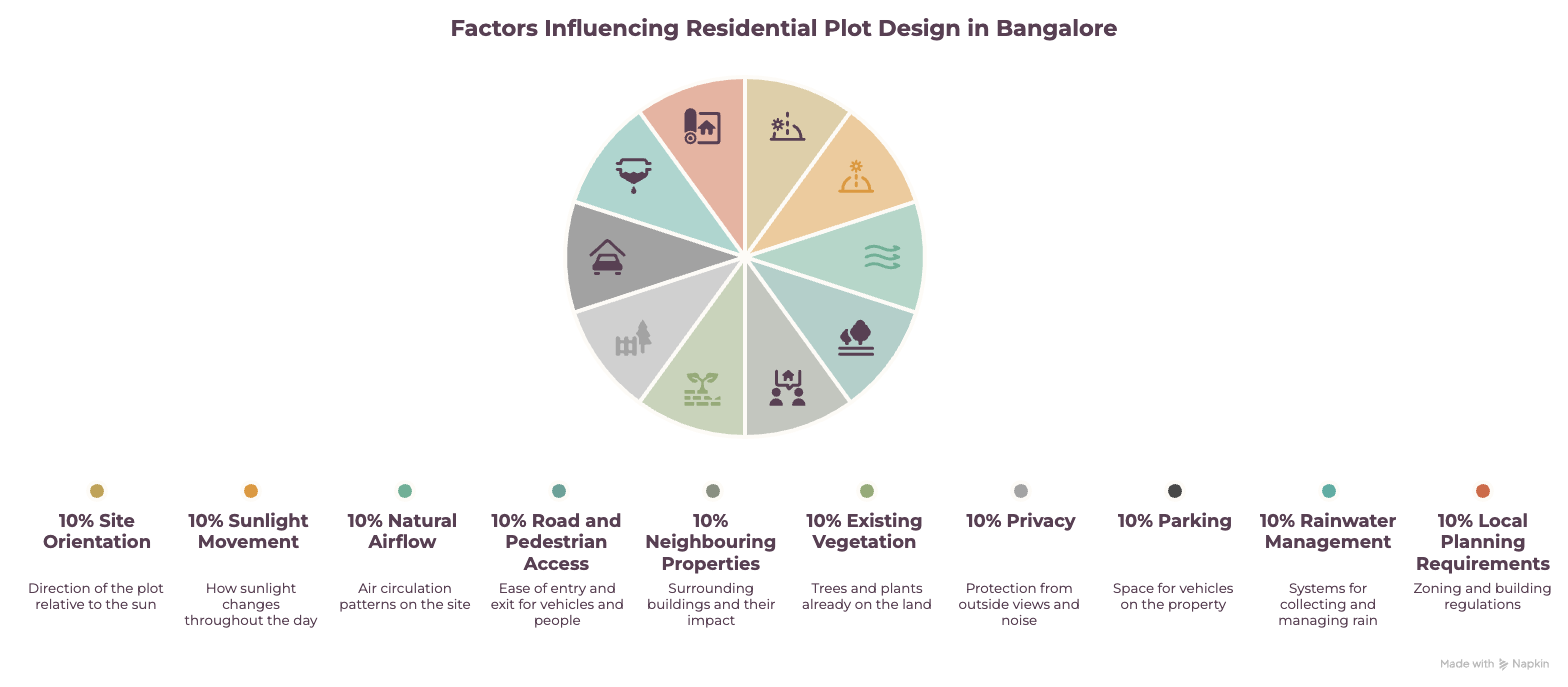
Your site’s orientation, road access, neighbouring buildings, existing trees, views, setbacks, privacy, and surrounding development can all influence the architectural solution.
Important factors may include:
- Site orientation
- Sunlight movement
- Natural airflow
- Road and pedestrian access
- Neighbouring properties
- Existing vegetation
- Privacy
- Parking
- Rainwater management
- Local planning requirements
This matters particularly in Bangalore, where residential plots can differ considerably from one neighbourhood to another.
A capable Residential Architect should be able to explain how your specific site could influence room placement, windows, outdoor areas, circulation, and overall planning.
What Does the Architectural Fee Actually Include?
Never assume that two architecture firms offering similar fees are providing the same service.
One firm may provide concept planning and architectural drawings, while another may also include detailed documentation, consultant coordination, material discussions, site visits, and construction-stage support.
Depending on the project, architectural services may include:
| Project Stage | Possible Service |
|---|---|
| Initial consultation | Project requirements and expectations |
| Site study | Analysis of plot and surroundings |
| Concept design | Initial architectural direction |
| Space planning | Room layouts and circulation |
| Design development | Refinement of the selected concept |
| Detailed drawings | Technical architectural documentation |
| Consultant coordination | Structural, electrical, plumbing, and other inputs |
| Material discussions | Finishes and architectural specifications |
| Site support | Design-related construction guidance |
The exact scope will differ between firms, so clarity is more important than assuming a standard package.
Can the Design Stay Within Your Planned Home Budget?
A visually impressive design is useful only if it can realistically be built.
Budget discussions should happen early, before the design becomes too detailed. You may not have an exact construction estimate at the beginning, but your architect should understand your approximate investment range.
The budget can influence:
- Built-up area
- Structural complexity
- Flooring
- Doors and windows
- Kitchen and storage
- Sanitary fittings
- Lighting
- Landscaping
- Custom furniture
- Interior finishes
The role of the architect is not simply to make everything cheaper. It is to help you decide where your money should create the greatest value.
For example, you may prioritise larger windows for better daylight and ventilation while choosing simpler finishes elsewhere. Another homeowner may prioritise a larger kitchen or more extensive storage.
A thoughtful Residential Architect should be comfortable having these conversations.
What Happens When You Want to Change the Design?
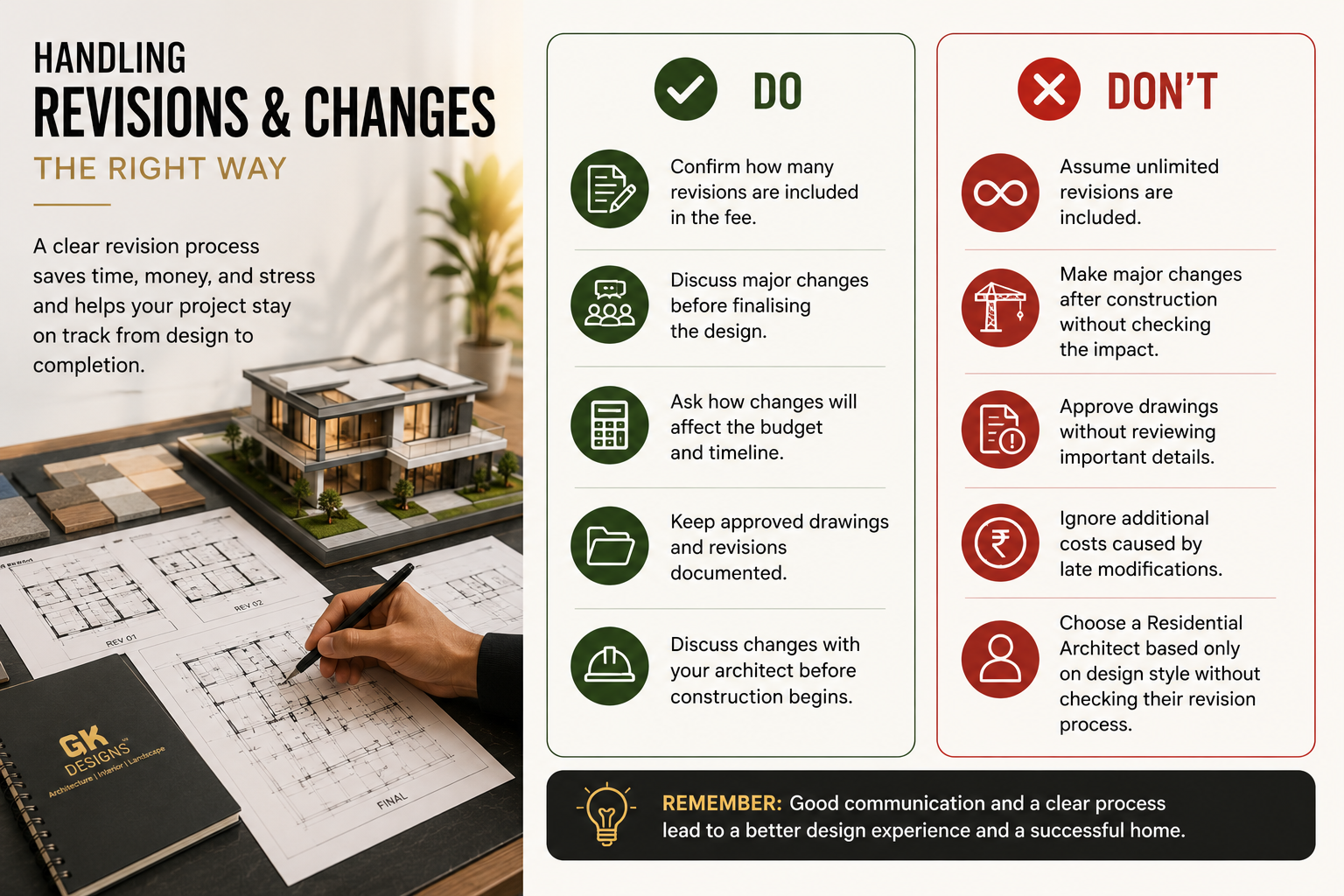
Design changes are common during a home project, but managing them properly can prevent delays, confusion, and unexpected costs.
Do:
- Confirm how many revisions are included in the fee.
- Discuss major changes before finalising the design.
- Ask how changes will affect the budget and timeline.
- Keep approved drawings and revisions documented.
- Discuss changes with your architect before construction begins.
Don’t:
- Assume unlimited revisions are included.
- Make major changes after construction without checking the impact.
- Approve drawings without reviewing important details.
- Ignore additional costs caused by late modifications.
- Choose a Residential Architect based only on design style without checking their revision process.
Who Will Guide You During Design and Construction?
Your relationship with the architect does not necessarily end when the floor plan is approved.
As construction progresses, questions can arise about drawings, dimensions, materials, details, and design changes. You should understand who will guide you through these stages.
Ask:
- Who will be your main point of contact?
- How frequently will meetings take place?
- How will drawings be shared?
- How are decisions recorded?
- Who coordinates consultants?
- Are site visits included?
- What construction-stage support is available?
- Who handles design-related clarifications on site?
It is also important to understand the difference between architectural responsibilities and contractor responsibilities.
When evaluating a Residential Architect, ask the firm to explain the project journey from the first concept through the construction stage.
Which Previous Projects Should You Review Before Hiring?
A portfolio can tell you a lot, but you should look beyond attractive photographs.
Ask to see projects that are relevant to your requirements. The projects do not need to look identical to your preferred style. What matters is whether the architect has experience solving similar problems.
For example:
- Compact urban plot → Review similar space-constrained projects.
- Large villa → Look for comparable project scale.
- Multigenerational home → Examine projects with flexible family spaces.
- Modern home → Review how the architect balances aesthetics and function.
- Complex site → Ask about projects with comparable site challenges.
Ask the architect to explain the reasoning behind selected projects.
Start With Your Family’s Real Needs, Not Just Design Trends
Pinterest boards and social media can be useful for collecting ideas, but they should not become the foundation of your entire design brief.
A home that looks impressive online may not suit your site, climate, family structure, maintenance preferences, or budget.
Instead, identify what you genuinely need.
Perhaps you need better storage rather than a larger living room. Maybe natural ventilation is more important than a dramatic facade. Perhaps you need a flexible room that can become a study today and a bedroom later.
Your architect can then use your preferences as inputs rather than simply reproducing an image you liked online.
Look for Relevant Experience Instead of a Beautiful Portfolio
A large portfolio is not automatically evidence that an architect is right for your project.
The strongest choice may be a firm that has handled projects similar to yours and understands the specific challenges involved.
Review the firm’s planning approach, attention to details, material choices, site response, and ability to work across different requirements.
This gives you a more useful picture of what you can expect.
The Right Questions Can Make Your Hiring Decision Easier
Choosing a Residential Architect in Bangalore should not be based solely on the lowest fee, the largest portfolio, or the most impressive elevation.
Find out how the architect understands your lifestyle, responds to your site, manages your budget, handles revisions, communicates during construction, and learns from previous projects.
At GK Designs, the objective should always be to approach residential architecture as a balance between design ambition and everyday functionality. A home needs to look considered, but it also needs to work comfortably for the people who live in it.
The right architect can help turn your requirements into a thoughtful design rather than forcing your needs into a predetermined template.